

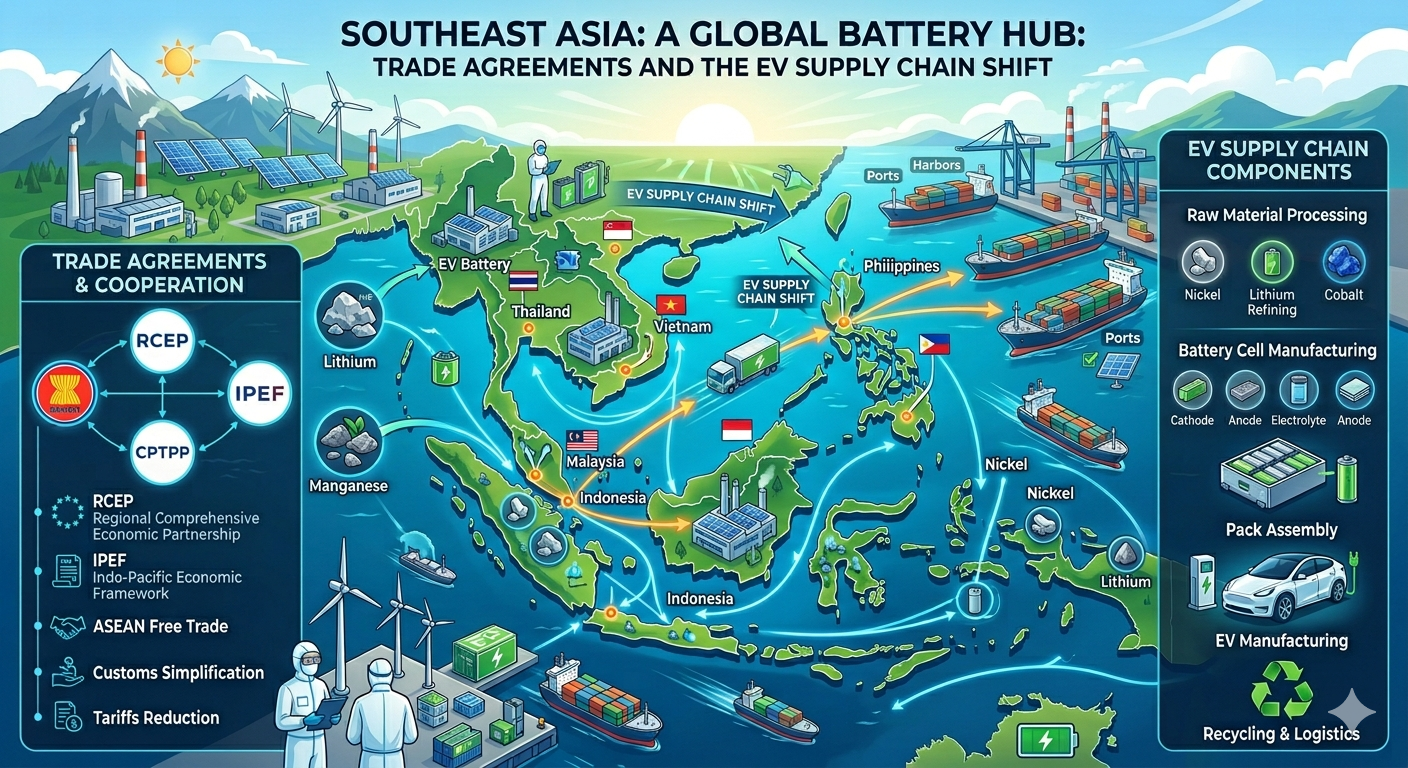
Southeast Asia’s rise as a battery hub is the result of decades of industrial growth, trade integration, and strategic policymaking. Since the late 20th century, countries like Thailand, Malaysia, and Indonesia built strong manufacturing bases in automotive assembly and electronics, attracting global investment through export-oriented policies.
Regional integration under the Association of Southeast Asian Nations (ASEAN) further strengthened this foundation. Trade frameworks such as AFTA enabled cross-border production networks, making the region an efficient hub for component manufacturing and assembly. By the 2000s, Southeast Asia had become a key player in global electronics, providing the technical capacity later needed for EV and battery technologies.
The shift toward battery production accelerated in the 2010s as global demand for electric vehicles grew, especially in China and United States. Indonesia’s large nickel reserves became a major advantage, and policies like its 2020 export ban pushed investment into local processing and battery manufacturing.
Recent disruptions, including the COVID-19 pandemic, encouraged companies to diversify supply chains beyond China, further boosting Southeast Asia’s role. Agreements such as the Regional Comprehensive Economic Partnership (RCEP) have also reduced trade barriers and supported regional supply chain integration.
One of the most important drivers of this shift is the reconfiguration of global EV supply chains away from overdependence on China. China currently accounts for roughly 70–75% of global lithium-ion battery production and over 60% of critical mineral processing capacity, including lithium, cobalt, and graphite. This concentration has raised concerns among major economies, prompting efforts to diversify supply chains. Southeast Asia has emerged as a strong alternative due to its proximity to China, established manufacturing ecosystems, and resource endowment. Most notably, Indonesia holds about 20–25% of the world’s nickel reserves and contributes over 45% of global nickel production – a critical material for EV batteries. To capture more value, Indonesia implemented a ban on raw nickel exports in 2020, which has since attracted over $20 billion in EV and battery-related investments from global manufacturers.
This shift is also reflected in investment flows across the region. Between 2020 and 2024, Southeast Asia saw EV-related investments exceed $30–40 billion, spanning battery plants, mineral processing, and vehicle assembly. Countries like Thailand aim to convert 30% of domestic vehicle production to EVs by 2030, while Vietnam is scaling domestic EV and battery production capacity.
Trade agreements across the Association of Southeast Asian Nations (ASEAN) have further accelerated this transition. Recent regional frameworks reduce tariffs on EV components and batteries, streamline customs procedures, and offer tax incentives for investors. These agreements effectively lower production costs and encourage multinational companies to establish operations within the region. By simplifying cross-border trade, ASEAN is enabling a more integrated EV supply chain where raw materials, intermediate components, and finished products can move efficiently across countries.
In practical terms, this shift has triggered a surge in investment across Southeast Asia, with both global and Chinese firms racing to localize EV supply chains. In Indonesia, projects like the Hyundai–LG Energy Solution battery plant (valued at over $1 billion) and multiple nickel-processing industrial parks illustrate how countries are moving beyond raw material exports into full-scale battery ecosystems. Similarly, Thailand has attracted major EV assembly and battery investments, supported by government subsidies of up to $4,000 per EV and tax incentives for manufacturers. Malaysia is focusing on high-value segments such as battery components and electronics integration.
As noted by Budi Gunadi Sadikin, “We don’t want to export raw materials anymore, we want to build the entire EV ecosystem here.” This reflects a broader regional strategy: capturing more value by linking mining, refining, cell production, and final vehicle assembly within the same geography.
Practically, this integration is happening through industrial clusters and special economic zones. For example, Indonesia’s Morowali Industrial Park combines nickel smelting with battery precursor production, reducing logistics costs and shortening supply chains. In Thailand, the Eastern Economic Corridor is being developed as an EV hub with dedicated infrastructure, streamlined customs, and local supplier networks.
At the same time, Southeast Asia’s established electronics base is being repurposed for EV technologies. Vietnam and Malaysia are expanding into battery management systems, semiconductors, and power electronics, critical components that can account for 30 – 40% of an EV’s total value. This shift is practical and strategic: rather than competing only on low-cost assembly, the region is moving into higher-margin, technology-driven segments of the EV value chain.
However, the region’s emergence as a battery hub is not without challenges. While assembly capacity is growing quickly, many countries still rely on imported battery cells and advanced materials. Midstream capabilities such as cathode production and electrolyte processing remain underdeveloped in several markets. This creates vulnerabilities in the supply chain and limits the region’s ability to capture higher-value segments of production.
Infrastructure constraints also pose practical hurdles. Efficient logistics systems for handling high-value, sensitive battery components are still evolving, and charging infrastructure, though expanding, remains uneven across countries. Despite the addition of tens of thousands of charging points in recent years, the pace of infrastructure development must keep up with rapid EV adoption to sustain growth.
Nevertheless, regional coordination is strengthening. ASEAN leaders have formally committed to building a unified EV ecosystem, emphasizing collaboration in research, investment, and policy alignment. This includes efforts to standardize regulations, promote sustainable resource use, and integrate small and medium-sized enterprises into the supply chain. Such coordination is crucial for ensuring that Southeast Asia competes not just as individual markets, but as a cohesive production hub.
Southeast Asia’s rise as a battery hub reflects a deeper shift in the global EV landscape. Trade frameworks like the Regional Comprehensive Economic Partnership and coordination under Association of Southeast Asian Nations (ASEAN) are lowering barriers and enabling integrated supply chains across countries. At the same time, resource advantages especially in Indonesian are anchoring upstream production, while nations like Thailand and Vietnam expand into manufacturing and assembly. Although gaps remain in technology, skills, and infrastructure, the region is steadily moving beyond low-cost assembly toward higher-value roles in the EV value chain. If this trajectory continues, Southeast Asia will not just participate in the global transition to clean mobility, it will help define it.
Leave a Reply