

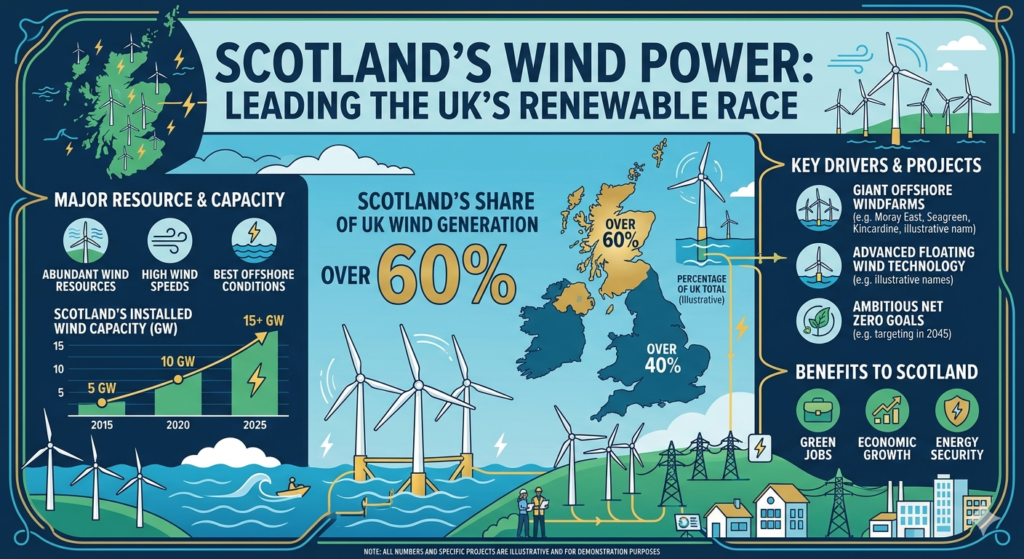
Scotland’s Wind Power: Leading the UK’s Renewable Race.
Scotland occupies a central position in the United Kingdom’s transition to cleaner energy. Vast coastlines, strong wind resources, and long-term policy commitments have strengthened its role in national electricity generation. Wind energy now contributes a significant share of Scotland’s power supply, while supporting wider UK ambitions for energy security, carbon reduction, and economic growth. As the UK accelerates its net-zero agenda, Scotland remains one of the most influential drivers of renewable development.
Expanding Onshore and Offshore Wind Capacity
Scotland’s renewable growth has been shaped by investments in both onshore and offshore wind projects. Large-scale wind farms have transformed rural landscapes and strengthened electricity generation capacity. Coastal regions have also benefited from offshore developments, where stronger and more consistent winds improve energy output.
The expansion aligns with broader UK climate commitments.Targets established under national net-zero policies continue to encourage renewable deployment. Offshore wind has attracted particular attention due to its potential for large-scale electricity generation. New projects are being developed across Scottish waters, creating additional capacity for future demand.
Technological improvements have also enhanced efficiency. Modern turbines generate more electricity while requiring fewer installations than earlier models. As a result, greater energy output can be achieved with improved operational performance. Scotland’s natural advantages have therefore become an important national asset within the UK energy system.
Policy Support and Strategic Direction
Government policy has played a major role in Scotland’s renewable success. The Scottish Government, operating through the Holyrood Parliament, has consistently promoted clean energy initiatives. Renewable energy targets, planning reforms, and investment frameworks have encouraged long-term sector growth.
These measures complement wider UK legislation aimed at reducing greenhouse gas emissions. Policy coordination between Scottish and UK authorities has created a supportive environment for renewable investment. Public and private sector collaboration has also strengthened project delivery.
Academic research frequently highlights policy certainty as a key factor in renewable expansion. Investors generally favour markets where long-term commitments remain clear. In Scotland, stable policy direction has helped attract funding for major wind developments. Consequently, renewable energy has become an increasingly important component of regional and national economic planning.
Creating Jobs and Supporting Regional Economies
Wind power development has generated economic opportunities across Scotland. Employment has expanded in construction, engineering, maintenance, logistics and environmental consultancy. Many communities have benefited from infrastructure projects associated with renewable installations.
Rural and coastal regions have experienced particular advantages. Areas previously dependent on traditional industries are exploring new opportunities within the renewable economy. Skills development programmes have also emerged to support workforce transitions.
Universities and technical institutions contribute through research and specialist training. Collaboration between industry and educational bodies helps prepare workers for evolving energy demands. Local businesses often benefit from supply chain participation, creating wider economic effects beyond direct employment.
The renewable sector therefore supports more than electricity generation. It contributes to regional development strategies while strengthening economic resilience in different parts of Scotland.
Supplying Renewable Energy Across the United Kingdom
Scotland produces more renewable electricity than it consumes during many periods of the year. Surplus energy is transmitted through the national grid to other parts of the United Kingdom, particularly England. This transfer strengthens overall energy security and supports national decarbonisation efforts.
Grid infrastructure has become increasingly important as renewable generation grows. Investment in transmission networks enables electricity to move efficiently between regions. Without such connections, the benefits of renewable expansion would be significantly reduced.
The relationship reflects the interconnected nature of the UK energy market. Energy generated in Scotland contributes to broader national objectives, while consumers across Britain benefit from cleaner electricity sources. As renewable capacity increases, Scotland’s contribution is expected to remain central to the UK’s energy transition.
Scotland’s wind sector continues to shape the future of British renewable energy.Through resource advantages, supportive policies, economic contributions and electricity exports, it remains a leading force in the United Kingdom’s pursuit of a cleaner and more sustainable energy system.
Leave a Reply