

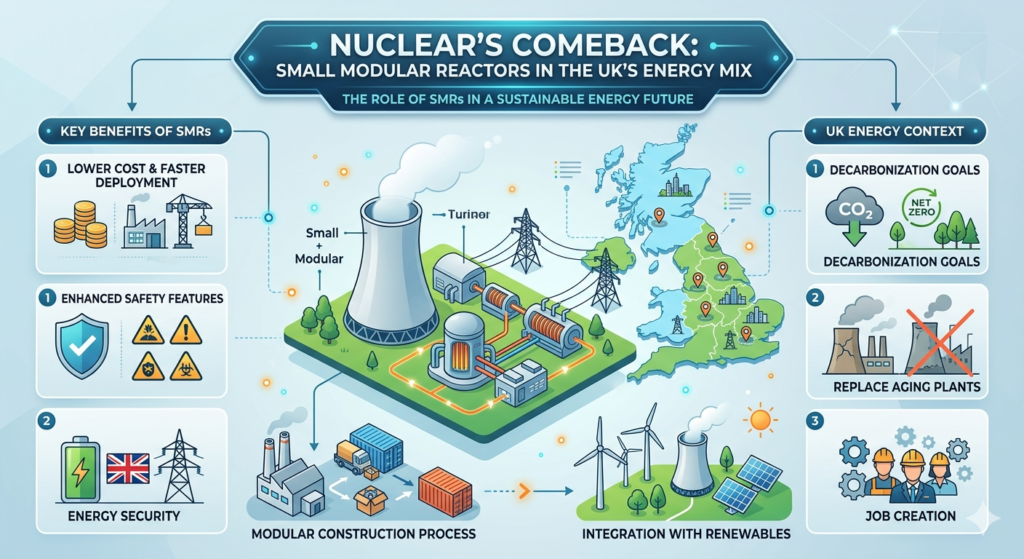
Nuclear’s Comeback: Small Modular Reactors in the UK’s Energy Mix.
The UK’s energy system faces a difficult balancing act. Demand is rising as electrification expands across transport and heating. At the same time, fossil fuel reliance is being reduced under legally binding net zero targets. In 2023, low-carbon sources generated over half of the UK’s electricity, yet supply gaps remain during low wind periods. Nuclear, once in decline, is being reconsidered as a stable complement to renewables.
The Sizewell C Push and SMR Development
Large-scale nuclear has not been abandoned. Sizewell C represents a continuation of traditional gigawatt-scale projects. It is expected to provide power to millions of homes once completed. However, financing challenges and construction delays have historically slowed such projects.
Attention is now shifting toward Small Modular Reactors (SMRs). These reactors are designed to be factory-built and assembled on-site. This approach could reduce costs and construction time. Rolls-Royce has positioned itself at the centre of the UK’s SMR ambitions. Its design promises consistent output with lower upfront investment compared to conventional plants.
Government backing has strengthened this direction. Funding competitions and regulatory support have been introduced to accelerate deployment. While SMRs remain under development, they are increasingly framed as a practical solution. Their smaller footprint also allows for flexible siting, including former industrial locations.
Policy Backing and Safety Considerations
The UK government has signalled clear intent through policy frameworks. Nuclear energy has been classified as a green investment under certain criteria. This classification has unlocked funding pathways previously reserved for renewables.
Public funding has been committed to both large projects and SMR research. The creation of Great British Nuclear reflects a coordinated effort to scale capacity. Regulatory bodies continue to assess safety standards rigorously. Nuclear safety remains a central concern, especially following global incidents in past decades.
Debates persist around waste management and long-term storage. While modern reactor designs claim improved safety features, scepticism has not disappeared. Environmental groups often argue that investment should prioritise renewables and storage technologies instead.
Despite this, energy security concerns have shifted perspectives. The volatility of gas markets has reinforced the need for domestic, stable generation. Nuclear is increasingly viewed through this lens rather than purely environmental terms.
Baseload Reliability in a Net Zero System
Renewable energy sources are inherently variable. Wind and solar output fluctuate with weather conditions. This variability creates challenges for grid stability. Energy storage solutions are advancing, yet large-scale deployment remains limited.
Nuclear power offers consistent baseload generation. It operates independently of weather patterns. This reliability makes it a valuable component in a diversified energy mix. Policymakers have acknowledged that renewables alone may not meet demand at all times.
SMRs could enhance this reliability further. Their modular nature allows incremental capacity additions. This reduces the risk associated with large, single-site investments. It also aligns with evolving grid demands.
Academic studies have highlighted the importance of firm low-carbon power. Without it, reliance on backup fossil fuels could persist. Nuclear, alongside technologies like hydrogen and carbon capture, is positioned as part of the solution.
Public Perception and Practical NecessityPublic opinion on nuclear energy remains divided. Concerns about safety, cost, and waste are frequently raised. Historical incidents continue to shape perceptions, even as technology evolves.
At the same time, climate urgency is influencing attitudes. Some communities are becoming more open to nuclear projects. This shift is often linked to concerns about energy affordability and security. Rising electricity prices have made stable generation more appealing.
Government communication strategies have aimed to rebuild trust. Transparency around safety and environmental impact is being emphasised. Local engagement has also increased in areas proposed for development.
However, resistance persists in certain regions. Planning approvals can still face delays due to opposition. Balancing local concerns with national energy priorities remains a challenge.
The broader narrative is gradually changing. Nuclear is being reframed not as a competitor to renewables, but as a complement. This framing reflects the complexity of achieving net zero in a reliable and affordable way.
Leave a Reply