

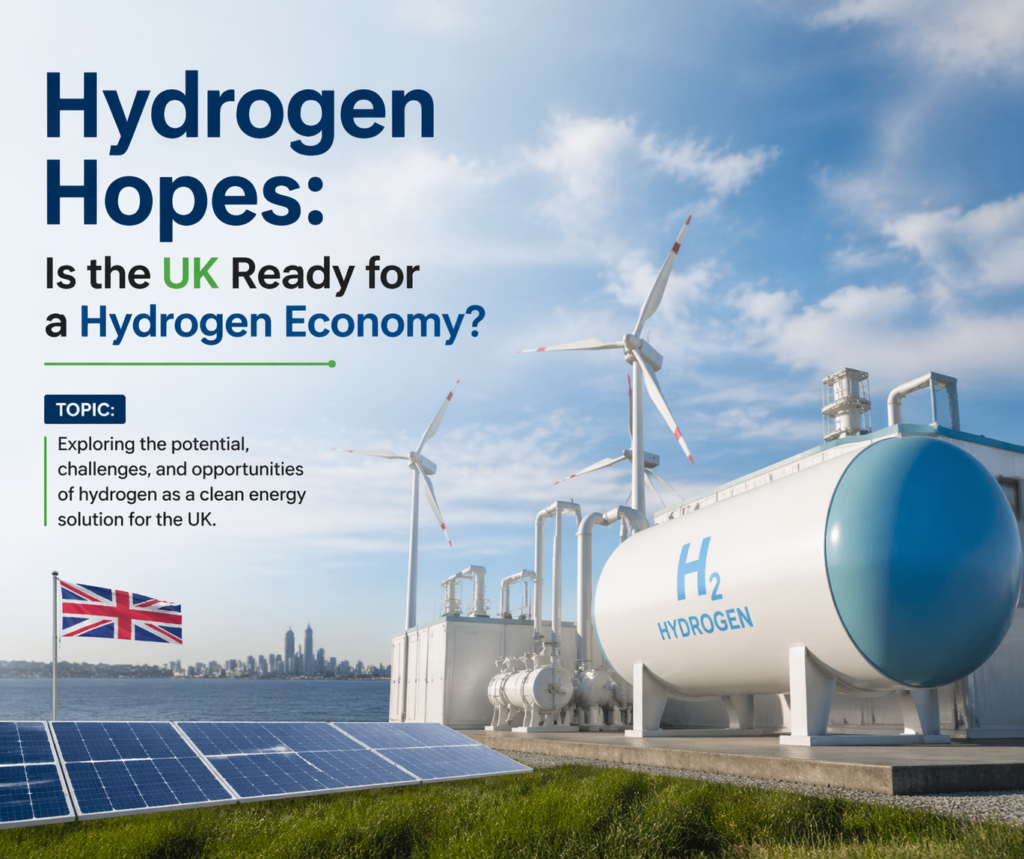
Hydrogen Hopes: Is the UK Ready for a Hydrogen Economy?
Setting the Pace: Policy Signals and Early Momentum
Hydrogen has moved from theory into policy language across the UK. The government’s Hydrogen Strategy (2021) set a target of 10GW low-carbon hydrogen production by 2030. At least half is expected to come from green hydrogen. Current output remains minimal, yet ambitions are unmistakably high.
The UK’s wider net-zero commitment, anchored in the Climate Change Act 2008, shapes this direction. Heavy industries still contribute a significant share of emissions. Transport, especially freight and shipping, continues to resist full electrification. Hydrogen is positioned as a solution where batteries struggle.
Reports from the International Energy Agency suggest global hydrogen demand could rise sharply by 2050. The UK aims to secure an early foothold in that market.Still, questions remain about cost, infrastructure and long-term demand certainty.
Blue vs Green Hydrogen: Efficiency Meets Ethics
Two dominant pathways define the UK’s hydrogen conversation. Blue hydrogen is produced from natural gas with carbon capture. Green hydrogen relies on renewable-powered electrolysis.
Blue hydrogen is currently cheaper and easier to scale. Existing gas infrastructure can support it with modifications. However, critics highlight methane leakage risks and incomplete carbon capture rates.
Academic studies from institutions like University of Oxford have questioned its long-term sustainability.
Green hydrogen, though cleaner, faces cost barriers. Electrolysers remain expensive and renewable supply must expand significantly. Yet, falling wind and solar costs offer optimism. The UK’s offshore wind capacity gives it a structural advantage here.
Policy frameworks attempt balance. The government’s “twin-track” approach supports both types. This hedging strategy reflects uncertainty rather than clarity. Over time, economic signals may determine which pathway dominates.
Industrial Clusters: Quiet Transformation in Motion
Hydrogen deployment is already being tested within industrial regions. Clusters such as Teesside and the Humber are central to these efforts. These areas host energy-intensive industries, making them ideal testing grounds.
Projects like the East Coast Cluster aim to integrate hydrogen production with carbon capture systems. This combination targets emissions reduction without dismantling existing industrial bases. The UK government has pledged funding through schemes like the Industrial Decarbonisation Challenge.
Private sector participation is also growing. Companies are investing in hydrogen ready infrastructure and pilot plants. Collaboration between public and private actors is shaping early momentum.
Evidence from early trials suggests technical feasibility. However, scalability remains uncertain. Infrastructure costs are substantial, and long-term returns depend on stable policy support.
Hydrogen Homes: A Social Experiment in Transition
Hydrogen is now entering domestic debates. Trials have explored blending hydrogen into existing gas networks. Some projects have tested 100% hydrogen heating in controlled environments.
The HyDeploy project demonstrated that up to 20% hydrogen blending is possible without changing appliances. Further trials, such as hydrogen village concepts, aimed to test full conversion feasibility.
Public acceptance, however, remains mixed. Concerns around safety, cost, and disruption persist. Regulatory bodies continue to assess risks and benefits.
In 2023, the UK government signaled caution by scaling back widespread hydrogen heating plans. Electrification through heat pumps is gaining stronger policy backing. Hydrogen may still play a niche role, particularly in hard-to-electrify buildings.
Infrastructure and Investment: The Missing Link
Hydrogen ambitions depend heavily on infrastructure development. Production alone is insufficient without transport and storage systems. Pipelines, storage facilities, and refueling stations require coordinated investment.
The UK is exploring repurposing existing gas networks. This approach could reduce costs and accelerate deployment.However, technical and regulatory challenges remain unresolved.
Financial mechanisms are evolving to support the sector. The Hydrogen Business Model introduces revenue support similar to offshore wind contracts. This aims to de-risk early investments and attract private capital.
Despite these efforts, funding gaps persist. Analysts argue that stronger policy certainty is needed. Without it, large-scale investment may remain cautious.
Global Context: Competing and Collaborating
The UK is not alone in pursuing hydrogen leadership. The European Union and countries like Japan are advancing their own strategies. Competition for technology, talent and investment is intensifying.
At the same time, collaboration is emerging through international agreements. Hydrogen trade could become a future energy market. The UK’s geographic position and port infrastructure may support this role.
Global demand projections remain uncertain. Adoption depends on cost reductions and policy alignment across countries. The UK’s success will partly depend on how quickly others move.
Leave a Reply