

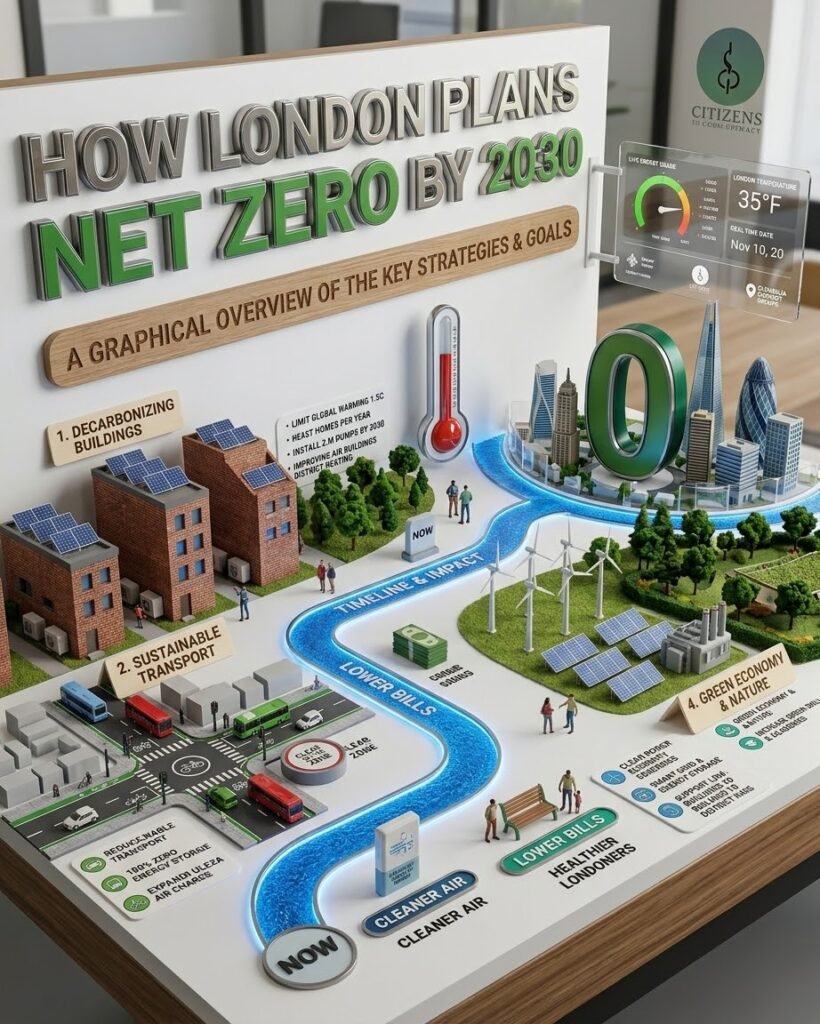
How London Plans to Hit Net Zero by 2030.
London has established an ambitious climate target that moves beyond the United Kingdom’s national net-zero deadline. The Mayor of London aims to make the capital a net-zero carbon city by 2030. Meanwhile, the UK’s Climate Change Act 2008 establishes a legally binding national target for net zero by 2050. The legislation was strengthened in 2019 to require a 100 per cent reduction in net greenhouse gas emissions against 1990 levels.
The difference reflects London’s intention to accelerate climate action through local government, infrastructure investment and changes in urban living. The Mayor’s preferred pathway, known as the Accelerated Green pathway, places energy-efficient buildings, cleaner transport and renewable energy at the centre of this ambition.
Transforming Transport Through Cleaner Alternatives
Transport remains a significant area of London’s decarbonisation strategy. The city is encouraging residents to reduce reliance on conventional petrol and diesel vehicles. Public transport, walking, cycling and electric vehicles are receiving greater attention as alternatives.
The Ultra Low Emission Zone (ULEZ) represents one of the most visible policy interventions. Introduced in central London in 2019, it now covers all London boroughs. Vehicles that fail to meet specified emissions standards attract a daily charge, encouraging owners to adopt cleaner alternatives.
Transport for London reported that harmful roadside nitrogen dioxide concentrations were estimated to be 27 per cent lower across London in 2024. This figure compares actual conditions with a modelled scenario without ULEZ and its expansions.
Electric vehicle adoption also forms part of the wider transition. Charging infrastructure must expand to support private motorists, commercial fleets and public services. The UK Government’s Zero Emission Vehicle Mandate reinforces this direction by requiring manufacturers to increase the proportion of new zero-emission cars and vans sold.
However, cleaner vehicles alone cannot deliver sustainable mobility. Greater investment in reliable public transport and active travel remains essential.
Retrofitting Buildings for Greater Energy Efficiency
Buildings represent another major challenge for London’s 2030 ambition. Heating, electricity consumption and inefficient building materials contribute substantially to urban emissions.
The Mayor’s Retrofit Accelerator programmes have supported improvements across residential and public buildings. Measures include insulation, efficient heating systems and renewable energy installations. These interventions reduce energy demand while improving indoor comfort.
London’s homes account for approximately one-third of the city’s greenhouse gas emissions. City Hall has also identified poor energy performance across a significant proportion of residential properties. Consequently, existing buildings must become a priority alongside new construction.
The UK Government’s Warm Homes Plan, published in January 2026, strengthens the national approach. It aims to improve housing efficiency, reduce household energy costs and expand access to low-carbon heating.
Local authorities, housing associations and private property owners will therefore remain important delivery partners. Nevertheless, funding constraints, installation costs and the complexity of older properties could slow implementation.
Expanding Local Renewable Energy Projects
London’s transition also depends on how electricity is generated, distributed and consumed. The Mayor is supporting decentralised energy initiatives that allow communities to participate directly in clean energy production.
The London Community Energy Fund provides financial support for locally developed renewable energy projects. These initiatives include solar photovoltaic installations, battery storage, heat pumps and energy-efficiency improvements.
By 2026, the programme had supported 194 community energy projects across 29 boroughs and the City of London. These projects had collectively delivered more than 3.7 megawatts of solar capacity.
The ninth funding phase continues this approach, with £1.3 million allocated across different funding streams. Community organisations can receive support for project development and implementation.
National initiatives are also creating opportunities for local energy development. Great British Energy’s Local Power Plan complements this direction by promoting community-owned energy and greater local participation. Such arrangements could reduce dependence on centralised energy supply while strengthening resilience. However, grid capacity, planning requirements and investment availability will influence how quickly projects expand.
City Hall’s Policy Direction and National Coordination
Achieving net zero requires consistent action across different levels of government. City Hall can influence transport, planning, public buildings and local investment. However, the national government retains responsibility for several important areas, including energy regulation and wider climate legislation.
The UK’s carbon budgets provide legally binding limits on greenhouse gas emissions over successive five-year periods. Its latest international commitment also targets an 81 per cent reduction in net greenhouse gas emissions by 2035, compared with 1990 levels.
London’s 2030 ambition therefore operates within a broader national framework. Collaboration between the Mayor, borough councils, businesses and national institutions will determine how effectively these commitments translate into measurable reductions.
Ultimately, London’s target demonstrates how local authorities can accelerate the UK’s climate transition. Its success will depend not simply on ambitious announcements, but on sustained investment, practical delivery and measurable improvements across the capital.
Leave a Reply