

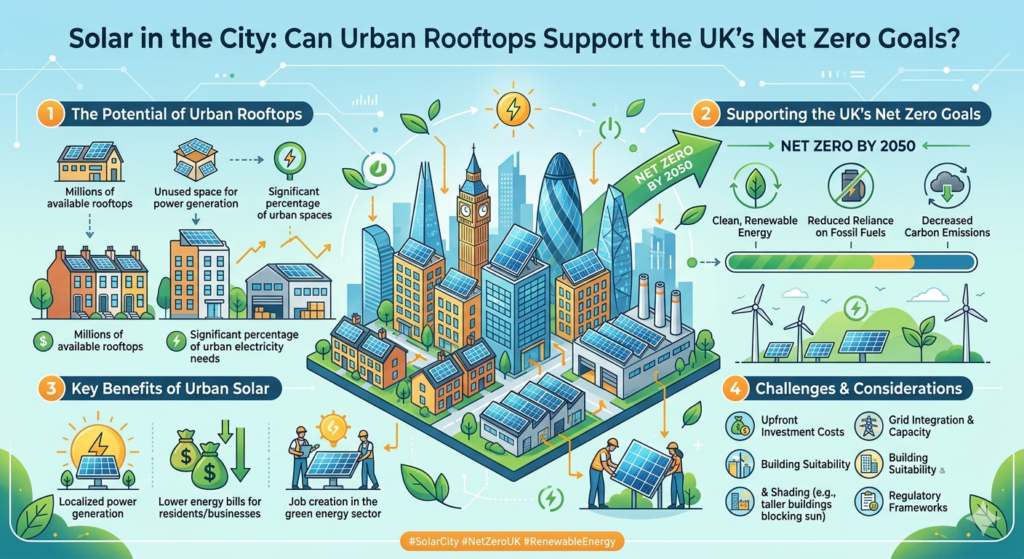
Solar in the City: Can Urban Rooftops Support the UK’s Net Zero Goals?
A Growing Shift Towards Urban Solar
Across Europe, rooftop solar adoption is rising at a steady pace. Urban centres are becoming active contributors to energy production. In the United Kingdom, this trend supports national climate commitments and policy reforms. The government’s Solar Strategy targets 70 gigawatts of solar capacity by 2035. Current solar output remains relatively modest within the national energy mix. However, increasing electricity costs and environmental concerns are driving new interest.
Cities present a unique opportunity for expansion. Rooftops, often underutilised, can support decentralised energy systems. This shift reflects a broader transition towards cleaner infrastructure. As demand grows, urban solar is gaining strategic importance. The question remains whether rooftops alone can significantly support net zero ambitions.
Strengthening Policy and National Commitments
The UK government continues to strengthen its renewable energy framework. The Solar Strategy outlines clear targets for long-term solar expansion. It promotes both large-scale projects and smaller rooftop installations. Planning regulations are gradually being simplified to encourage adoption. Financial incentives also support households and commercial entities.
Local authorities are aligning with these national objectives. Many councils now include solar targets within development plans. Building regulations are evolving to prioritise sustainability and efficiency. Some proposals suggest mandatory solar panels for new buildings. These measures reflect a proactive policy direction.
Despite progress, several barriers remain. Grid capacity requires upgrades to support decentralised inputs. Policy consistency is still essential for investor confidence. Developers often face delays due to regulatory complexities. Nevertheless, the overall direction remains positive.
Driving Change Through Active Solar Adoption
Active approaches focus on deliberate investment in solar technologies. Businesses and homeowners are installing rooftop systems at increasing rates. Commercial buildings provide ideal conditions due to large surface areas. Warehouses, offices, and retail centres are leading this transition.
Community solar initiatives are also expanding. These schemes allow shared access to solar energy benefits. They are especially useful for individuals without suitable rooftops. Cooperative ownership models strengthen local participation and engagement.
Technological improvements are accelerating adoption. Solar panels are becoming more efficient and affordable. Battery storage systems enable energy retention for later use. This reduces dependence on the national grid during peak demand periods. Smart systems also improve monitoring and energy management.
Financial returns are becoming more attractive. Many installations now achieve payback within seven to ten years. Government-backed schemes and green financing options reduce upfront costs. These active strategies are transforming urban energy systems.
Embedding Solar into Urban Planning and Design
Passive approaches focus on integrating solar into existing and future developments. New buildings are increasingly designed with solar-ready features. Roof orientation and structure now consider sunlight exposure. This ensures better efficiency without major modifications.
Building-integrated photovoltaics are gaining attention. These systems blend solar panels into construction materials. They maintain visual appeal while generating electricity. This approach is particularly suitable for dense urban environments.
Retrofitting older buildings remains a priority. Structural upgrades improve compatibility with solar installations. Insulation improvements also enhance overall energy efficiency. These changes support long-term sustainability goals.
Public awareness plays a significant role in adoption. Educational campaigns highlight the benefits of solar energy. Households become more mindful of energy consumption patterns. Academic research also supports decentralised energy systems. Passive strategies create a supportive environment for solar growth.
Rethinking Energy Use and Grid Dependence
Rooftop solar is reshaping how energy is produced and consumed. Traditional systems relied heavily on centralised power stations. Solar introduces a more distributed and flexible model.
This transition improves energy resilience. Homes and businesses can generate electricity independently. Stored solar energy provides backup during supply disruptions. This is valuable in densely populated cities.
However, full independence from the grid remains unlikely. Solar generation depends on weather and daylight conditions. The national grid continues to balance supply and demand. Hybrid systems offer the most practical solution.
Energy providers are adapting to these changes. Smart grids and flexible tariffs support decentralised generation. Over time, the grid may function as a shared energy network. Solar energy will remain central to this evolution.
The Future of Rooftops in a Net Zero Britain
Urban rooftops are becoming vital assets in the UK’s journey toward net zero emissions. With supportive policies and advancing technology, solar adoption continues to grow. Both active investments and passive design strategies are shaping this transition.
Challenges such as grid capacity and policy consistency still exist. However, the overall outlook remains promising. Rooftop solar alone may not achieve net zero goals. It remains a critical part of the broader energy transition.
City skylines may soon serve a dual purpose. They will support both daily living and energy generation.
Leave a Reply