

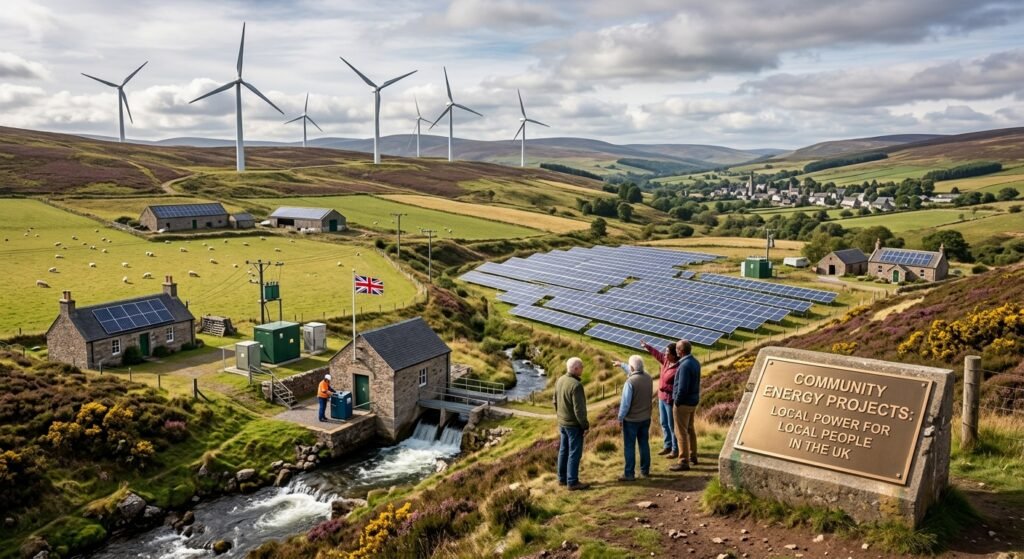
Community Energy Projects Local Power for Local People in the UK.
The UK’s energy transition is increasingly moving beyond large national infrastructure Communities are being positioned to generate own and benefit from clean energy locally.
The shift is significant because community energy connects decarbonisation with local economic development It can also strengthen public participation in the countrys clean energy transition.
Local Ownership and Community Co-operatives
Community energy allows residents co operatives charities and local authorities to participate in energy generation. Solar panels wind turbines and small hydro schemes can be owned collectively Profits can then be reinvested into community facilities or local priorities.
The model also creates opportunities for residents to become shareholders Community shares have been identified as an important financing mechanism within the UK sector.
This approach changes the relationship between communities and energy infrastructure Local people become participants rather than simply consumers
Research has also found that cooperative ownership can increase public support for renewable energy projects.
Policy Support Is Moving Towards Local Power
The UK’s 2014 Community Energy Strategy established an early policy framework for grassroots energy. It recognised community generation energy efficiency local finance and demand management as valuable tools.
Policy has since developed towards broader local energy participation. The 2024 Strategy and Policy Statement reinforced clean energy security and consumer protection as national priorities. A major development arrived in 2026 through the Local Power Plan. The Government and Great British Energy committed up to 1 billion towards local and community owned clean energy.
The plan aims to support more than 1000 local and community energy projects
This represents a substantial shift from isolated grassroots projects towards structured national support.
Local Councils Can Turn Policy Into Projects
Local authorities occupy an important position between national energy policy and community needs. Councils understand their buildings housing stock land businesses and local infrastructure That knowledge can help identify practical opportunities for renewable generation.
Partnerships are already producing measurable results Newport City Council worked with Egni Co op to install 6713 solar panels across 27 sites.
In England, Staffordshire Community Energy partnered with Cannock Chase Council on solar installations across 314 council bungalows. Such partnerships demonstrate how public assets can support local clean energy generation.
However, councils also require appropriate funding technical expertise and organisational capacity Current government support increasingly addresses these barriers.
Evidence From Communities Across the UK
Successful projects already exist across England Scotland and Wales. In Scotland, Huntly Development Trust owns one wind project and collaborates on two others Income supports local priorities including community buildings and wildlife protection.
Wales offers another example through shared ownership The Alwen Forest project allows a community organisation to own 15 percent of the wind project.
These examples demonstrate that ownership can extend beyond financial returns. Community energy can support local facilities environmental initiatives and wider economic resilience.
Academic research similarly suggests that community schemes can deliver social benefits alongside renewable generation.
From National Targets to Local Participation
The UK’s clean energy ambitions will require investment at multiple levels. Large infrastructure remains important but smaller projects can complement national generation capacity.
Distributed generation can also support a more resilient energy system. The Great British Energy identifies local ownership as an important part of its wider energy strategy
The challenge now lies in turning policy ambition into accessible opportunities for communities. Funding must reach projects that can demonstrate genuine local value Councils and community organisations must also receive practical support. When local people can help finance their own and benefit from energy infrastructure national climate objectives become more tangible.
The direction is increasingly clear; Britain’s energy transition will not only happen through national institutions It can also be built from the communities that use the energy every day.
Leave a Reply