

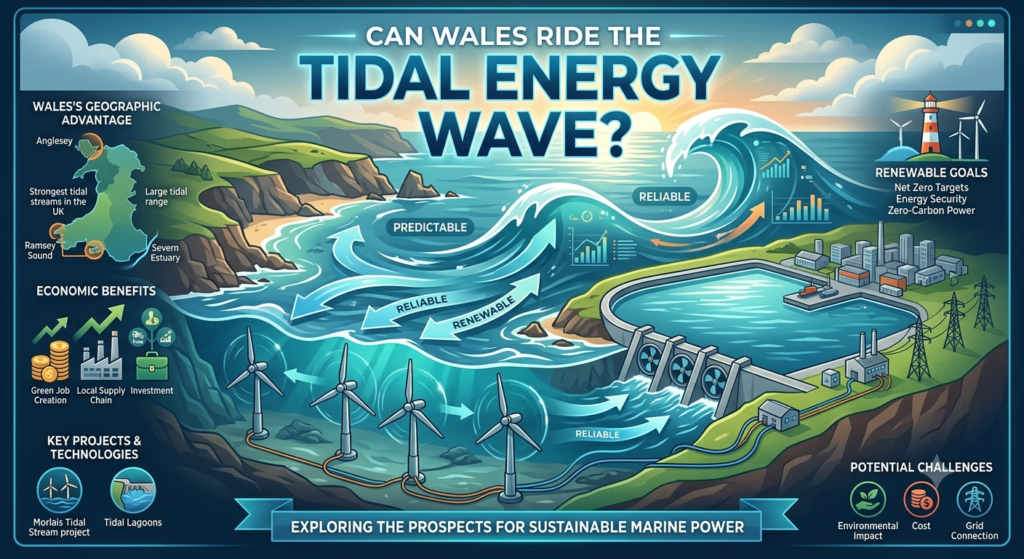
Can Wales Ride the Tidal Energy Wave?
The United Kingdom possesses one of Europe’s strongest marine energy resources. More than 12,000 kilometres of coastline surround the nation, creating significant opportunities for tidal power generation. Wales occupies a strategic position within this landscape. The Severn Estuary alone has one of the world’s highest tidal ranges, reaching up to 14 metres in some locations. As the UK pursues net-zero targets and energy security, interest in harnessing predictable tidal resources has returned to policy discussions.
Revisiting the Severn Barrage Debate
For decades, the Severn Barrage has remained one of Britain’s most debated renewable energy proposals. The concept involves constructing a large barrier across the Severn Estuary to generate electricity from tidal movements.
Supporters argue that the project could provide substantial low-carbon electricity for millions of homes. Unlike wind and solar power, tidal energy follows predictable patterns. Energy output can therefore be forecast with greater accuracy.
Environmental concerns have nevertheless shaped the debate. Questions have been raised regarding wildlife habitats, sediment movement, and ecosystem disruption. Several studies were commissioned by government bodies to assess these implications. Despite extensive analysis, no final decision was reached.
The proposal continues to attract attention because energy security has become a national priority. Rising demand for clean electricity has encouraged policymakers to reconsider previously shelved infrastructure projects.
Swansea Lagoon and Emerging Alternatives
The conversation around tidal power has gradually shifted towards smaller-scale developments. The proposed Swansea Bay Tidal Lagoon became a notable example of this approach.
Rather than spanning an entire estuary, the lagoon design aimed to capture tidal flows within a contained structure. Advocates presented it as a lower-risk alternative to the Severn Barrage. It was also promoted as a catalyst for regional economic growth.
Although government support was ultimately withheld, the project influenced future discussions. New tidal streams and lagoon technologies have since been explored across Welsh waters.
Research institutions continue to collaborate with industry stakeholders. Academic studies from Welsh universities have examined the technical and environmental performance of marine energy systems. These findings have contributed to broader conversations about sustainable coastal development.
Funding Challenges and Project Feasibility
Financial considerations remain a significant barrier to large-scale tidal infrastructure. Construction costs are often substantial. Long development timelines can also discourage private investment.
The challenge is not unique to Wales. Renewable energy projects across the UK frequently compete for public funding and policy support. Investors generally favour technologies with established commercial records.
Tidal energy occupies a different position. Its reliability is widely recognised, yet commercial deployment remains limited. As a result, government intervention is often viewed as necessary during early stages.
Recent UK energy strategies have highlighted the importance of diversifying renewable energy sources. However, funding mechanisms must balance affordability, environmental protection, and long-term value for taxpayers. These competing priorities continue to shape investment decisions.
Marine Energy and Future Policy Opportunities
The UK’s commitment to achieving net-zero emissions by 2050 has renewed interest in marine energy. Policymakers increasingly recognise the value of predictable renewable resources.
Several opportunities are emerging. Targeted support schemes could encourage innovation and reduce development risks. Regional partnerships may also strengthen local supply chains and create skilled employment.
Policy discussions increasingly emphasise resilience. Dependence on imported energy has exposed vulnerabilities in recent years. Domestic renewable generation therefore carries strategic importance.
International frameworks on climate action have reinforced these ambitions. Academic literature frequently highlights the need for diversified energy portfolios. Marine technologies are often identified as an underutilised component of this transition.
Wales remains well positioned to contribute. Its coastal geography, engineering expertise, and renewable energy ambitions provide a strong foundation. Whether through a revived Severn Barrage or newer technologies, marine energy could play a greater role in the UK’s future energy mix.
The debate is no longer solely about one project. It concerns how Britain chooses to utilise its natural resources in pursuit of sustainability, economic growth and long-term energy security.
Leave a Reply