

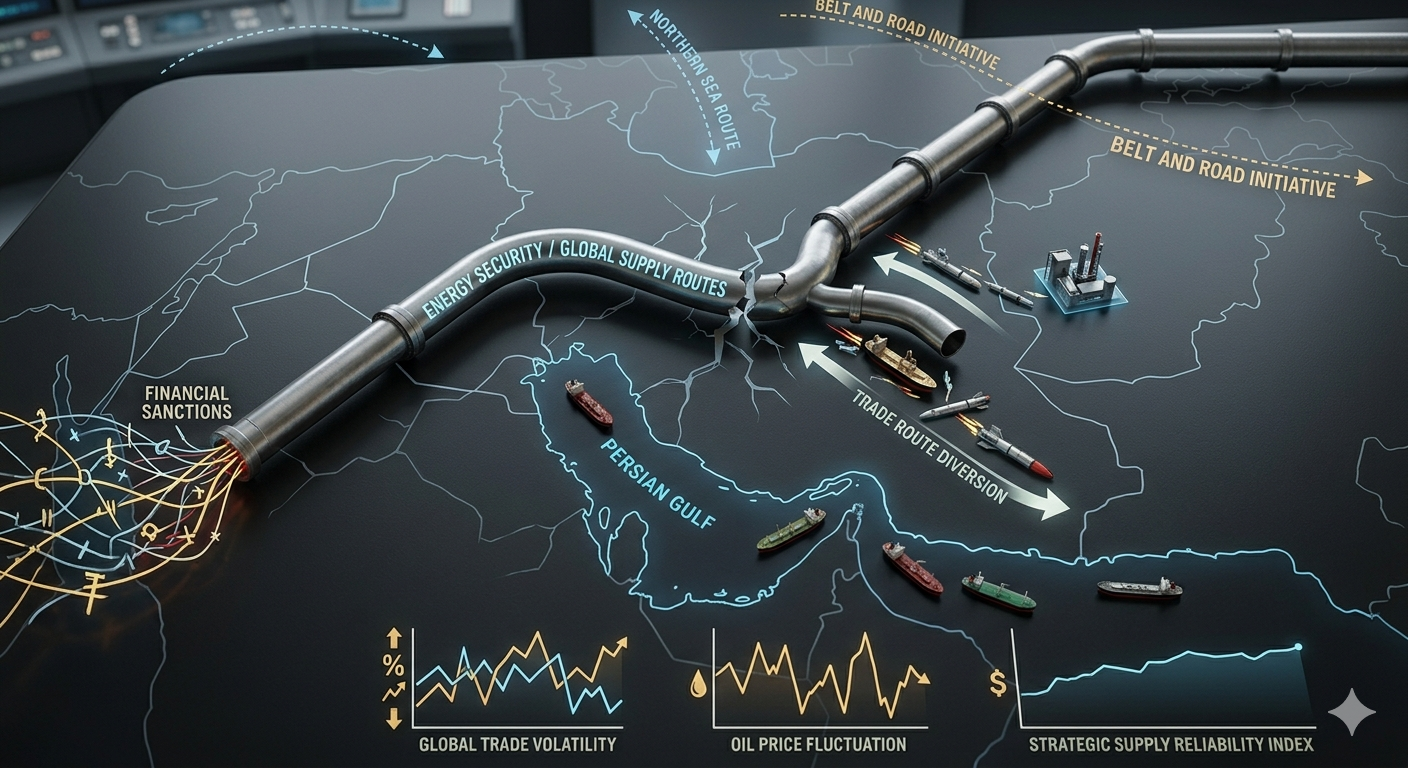
“Freedom of navigation in the Strait of Hormuz is a vital national interest of the United States and the global economy,” noted Antony Blinken, a statement that reflects the growing global significance of tensions between the United States and Iran. For more than four decades, relations between both countries have been shaped by sanctions, nuclear disputes, ideological rivalry, and competition for influence in the Middle East. What began as a bilateral political conflict after the 1979 Iranian Revolution has gradually evolved into an issue with worldwide economic and geopolitical consequences. Today, U.S.–Iran tensions are no longer confined to diplomacy alone; they are increasingly reshaping global energy markets, international trade systems, shipping routes, and strategic alliances.
At the center of this transformation lies the Strait of Hormuz, one of the world’s most important maritime chokepoints. Nearly one-fifth of the world’s oil supply passes through this narrow waterway daily, making it critical to global energy security. Any threat of military escalation or disruption in the region immediately affects international oil prices, transportation costs, inflation, and global supply.
For decades, sanctions have been the primary tool used by the United States to limit the economic influence of Iran. These restrictions have targeted oil exports, banking systems, and international trade, aiming to reduce Iran’s access to global markets. At their peak, sanctions cut Iran’s crude oil exports from over 2.5 million barrels per day in the early 2010s to below 1 million barrels per day, significantly reducing state revenue.
However, the prolonged standoff has created unintended global consequences. Instead of fully isolating Iran, it has encouraged alternative trade routes, discounted oil sales of about 10–30% below market prices, and increased reliance on Asian buyers. It has also pushed partial shifts in payment systems away from the U.S. dollar, contributing to more fragmented and complex global energy trade patterns.
One of the clearest impacts has been on global energy security. Repeated tensions surrounding the Strait of Hormuz have made oil markets extremely sensitive to geopolitical signals, even without actual disruption. Nearly 20% of global oil supply and a significant share of liquefied natural gas from Gulf producers pass through this narrow corridor daily, making it one of the most critical chokepoints in global trade. Because of this dependence, even the ‘risk’ of closure can trigger immediate market reactions. In past escalation episodes, Brent crude prices have jumped by 5–15% within daysj, reflecting how quickly traders price in potential supply shocks. Analysts estimate that a full or prolonged closure could remove up to 17–18 million barrels per day from global markets, an outcome that could push oil prices far beyond historical highs and create a severe global inflationary spiral.
These tensions have also forced countries to rethink energy dependence in more structural ways. Major Asian economies such as China, India, Japan, and South Korea collectively import a large share of their crude oil – much of it sourced from the Gulf region. For example, China imports over 10 million barrels of crude oil per day, with a significant portion linked to Middle Eastern supply chains, while India relies on imports for roughly 85% of its total oil consumption. This heavy reliance has intensified concerns about exposure to geopolitical instability in the Gulf.
As a result, many countries have adopted layered energy security strategies. These include expanding strategic petroleum reserves – often covering 60 to 100 days of consumption in advanced economies, diversifying suppliers toward Russia, Africa, and the Americas, and accelerating investment in renewable energy systems such as solar, wind, and hydrogen. Japan and South Korea, for instance, have significantly increased liquefied natural gas storage capacity to reduce vulnerability to maritime disruption.
The combined effect of these shifts is a gradual restructuring of global energy planning. Rather than relying on single-source supply routes, governments are increasingly building redundancy into their energy systems. This transition is not only about climate policy but also about geopolitical risk management, driven in large part by the persistent uncertainty surrounding U.S.–Iran tensions and the strategic vulnerability of the Strait of Hormuz.
At the same time, U.S.–Iran tensions are reshaping international trade systems. Because sanctions limit Iran’s access to Western banking networks, countries and companies trading with Tehran have increasingly experimented with non-dollar transactions, barter agreements, and regional payment systems. Recent reports suggest that some oil transactions and shipping arrangements are increasingly bypassing the U.S. dollar altogether. This trend challenges the dominance of the “petrodollar” system, which has historically strengthened American financial influence in global markets.
China plays a particularly important role in this evolving landscape. As Iran’s largest oil customer and strategic partner, Beijing has deepened economic cooperation with Tehran despite U.S. pressure. Through long-term investment agreements and energy partnerships, China has positioned itself as a key actor in Iran’s economic survival. This growing relationship reflects a larger geopolitical shift in which emerging powers seek alternatives to Western-controlled financial and trade systems.
Meanwhile, maritime trade itself is becoming more expensive and uncertain. Shipping companies operating near the Persian Gulf face rising insurance costs, security concerns, and longer transit routes. Some vessels now avoid the region entirely during periods of escalation, rerouting around Africa at higher cost and longer delivery times. These disruptions affect not only oil shipments but also global supply chains, contributing to inflationary pressures worldwide.
The conflict has also accelerated the rise of “shadow trade” networks. Iran has increasingly relied on covert shipping methods, intermediary companies, and alternative currencies to continue exporting oil despite sanctions. This has created less transparent global energy markets and weakened the effectiveness of traditional economic pressure tools. Reports even suggest experiments involving cryptocurrencies and digital financial mechanisms tied to Gulf shipping operations.
Beyond economics, the tensions are reshaping international alliances. Gulf states that were once firmly aligned with Washington are increasingly balancing relations between the United States, China, and regional powers. Countries are prioritizing economic stability and energy security over strict geopolitical loyalty. This reflects a broader movement toward a more multipolar global order where influence is distributed across several competing powers rather than dominated by a single superpower.
Importantly, the consequences are not limited to the Middle East. Rising oil prices caused by instability affect transportation, manufacturing, food production, and inflation worldwide. This hit developing economies the hardest because they depend heavily on imported fuel and have fewer resources to absorb economic shocks. In this sense, U.S.–Iran tensions have become a truly global issue rather than a regional dispute.
The U.S.–Iran rivalry has moved far beyond sanctions and diplomacy, now reshaping global energy markets, trade routes, financial systems, and international alliances. As countries adapt through new partnerships, alternative payment systems, and shifting energy strategies, geopolitical tension is increasingly defining economic realities worldwide. Ultimately, political hostility shapes more than outcomes; it transforms the global order itself over the long term.
Leave a Reply