

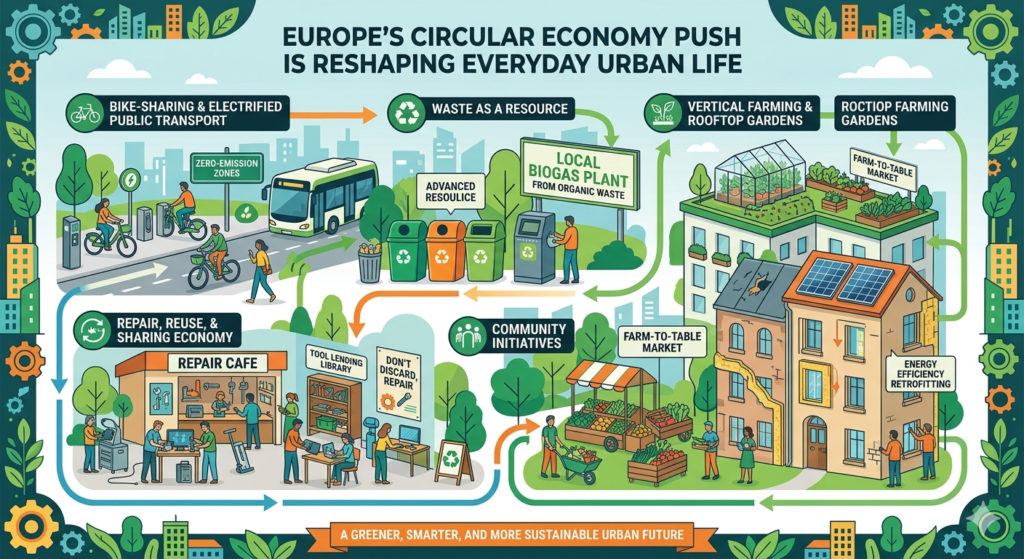
Europe’s Circular Economy Push Is Reshaping Everyday Urban Life.
Europe’s waste problem no longer sits quietly behind industrial fences. Landfills across the continent remain under pressure. Recycling targets have also become politically sensitive. The European Union generated more than two billion tonnes of waste in recent years. Municipal waste alone keeps rising in several states.
At the same time, energy prices continue affecting manufacturing and household spending. Cities now face pressure from climate groups, economists, and younger voters. Governments are responding through circular economy policies and urban redesign projects.
The conversation has shifted beyond recycling bins and reusable shopping bags. Attention now focuses on how European cities consume, repair, and redistribute materials.
Repair Culture Is Returning to European Streets
Repair cafés were once viewed as niche community activities. Now, they are influencing wider economic discussions across Europe. In France, repair incentives were introduced for electronics and household appliances. Consumers receive discounts when damaged products are repaired instead of replaced. The policy was designed to reduce electronic waste volumes nationwide.
Germany has expanded funding for community repair workshops. Some local councils also support shared tool libraries. Old bicycles, radios, and kitchen devices are increasingly repaired collectively. This trend reflects changing attitudes toward ownership and consumption.
Meanwhile, Scandinavian cities continue promoting low-waste urban living. In Sweden, second-hand shopping has gained social prestige among younger residents. Vintage markets now attract middle-class professionals and students alike. The stigma once attached to reused products has weakened significantly.
Academic researchers continue supporting these behavioural changes. Several European universities have published studies linking repair culture with reduced emissions. Scholars also connect local repair economies with stronger neighbourhood relationships. The environmental discussion has therefore become partly social.
Food Systems Are Quietly Entering Climate Negotiations
European climate discussions once focused heavily on transport and energy production. Food systems now occupy larger policy spaces. Agricultural emissions remain difficult to reduce across several member states. Farmers continue protesting environmental restrictions in countries like the Netherlands and Belgium.
However, dietary discussions are changing public conversations gradually. Plant-based food industries have expanded across urban Europe. Restaurants increasingly advertise locally sourced ingredients and seasonal menus. Food waste reduction campaigns have also intensified.
In Italy, supermarkets donate unsold products through organised redistribution networks. French legislation also discourages large retailers from destroying edible food. These policies were introduced after rising criticism from environmental groups.
Religious organisations have entered the debate as well. Catholic environmental advocacy has influenced sustainability conversations in southern Europe. Faith-based charities now support food redistribution and urban farming programmes.
The European Green Deal continues shaping these transitions. It’s agricultural strategies encourage biodiversity protection and reduced pesticide dependence. Still, resistance remains visible among farming unions and rural communities. Many fear economic instability during environmental reforms.
Housing Policies Are Being Forced Into the Climate Debate
Europe’s housing crisis increasingly overlaps with climate concerns. Older buildings consume large amounts of energy during winter months. Millions of apartments were constructed before modern efficiency standards existed.
Governments are now funding renovation programmes aggressively. Heat pump installations have increased across several European capitals. Insulation upgrades are also being encouraged through tax incentives.
In Spain and Portugal, warmer summers have intensified housing concerns. Air conditioning demand continues growing in urban areas. Architects therefore discuss passive cooling methods more frequently.
Historic preservation rules sometimes complicate energy upgrades. Many older buildings cannot easily accommodate modern installations. As a result, policy disagreements have emerged between conservation groups and climate advocates.
Meanwhile, younger Europeans increasingly favour compact urban living. Car-free neighbourhoods receive stronger support among students and remote workers. Public transport investment has therefore gained renewed political value.
Scholarly articles continue examining these housing transitions carefully. Researchers often link energy-efficient housing with improved public health outcomes. Poorly insulated homes have long affected vulnerable populations disproportionately.
Europe’s Green Transition Still Faces Economic Friction
European leaders frequently describe sustainability as an economic opportunity. Yet, the transition remains uneven across regions. Eastern European industries still depend heavily on carbon-intensive production. Coal communities fear unemployment and economic decline.
The European Union has introduced transition funds for affected regions. Training programmes are also being expanded for green-sector employment. However, implementation gaps continue frustrating local communities.
Global competition further complicates Europe’s ambitions. Chinese electric vehicle production has intensified market pressures recently. American clean energy subsidies have also attracted European manufacturers abroad.
Despite these tensions, public expectations continue evolving. Consumers increasingly question how products are sourced and manufactured. Corporate sustainability reports now influence investment discussions significantly.
Environmental policy is no longer treated as a separate political issue. It now shapes conversations about trade, migration, public health, and security. Europe’s circular transition therefore reflects more than climate ambition alone. A different economic identity is gradually being negotiated across the continent.
Leave a Reply