

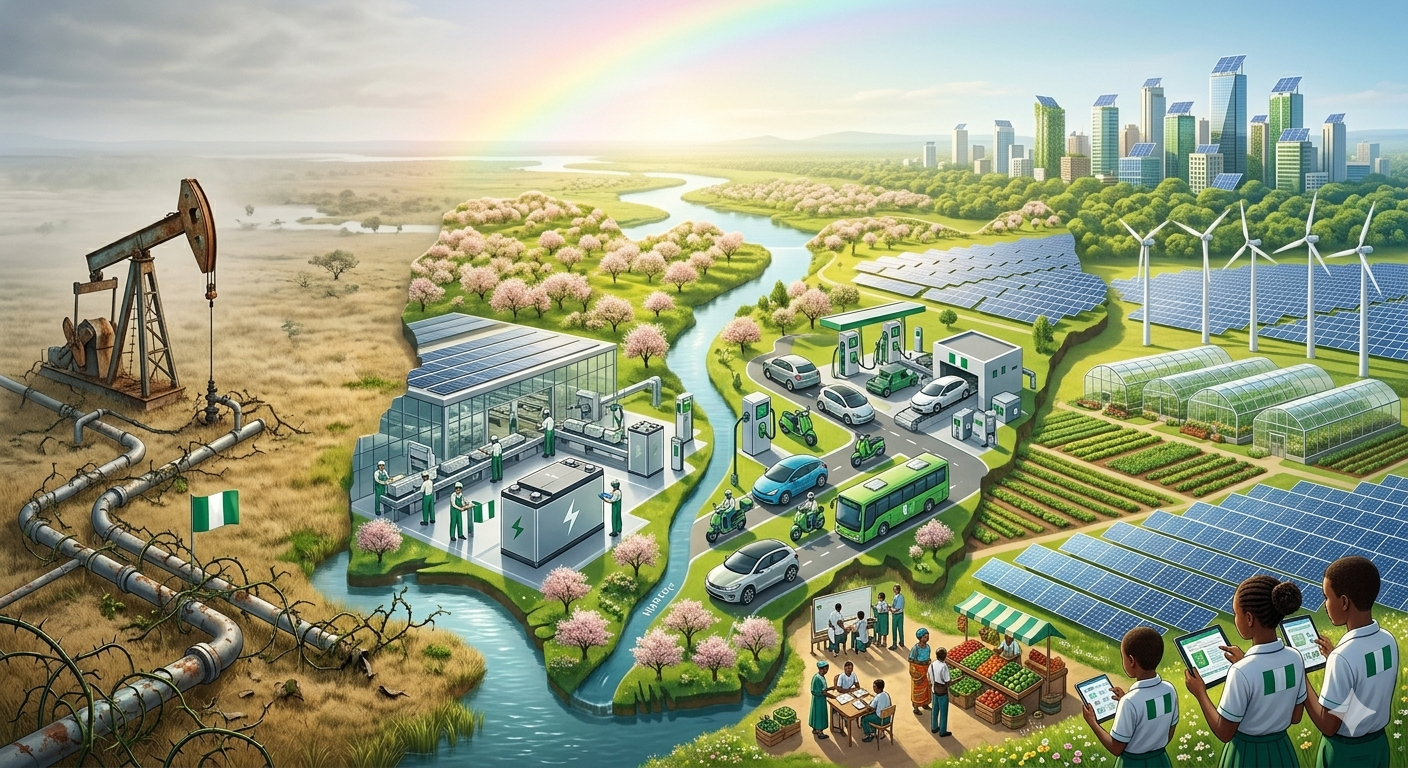
Since the discovery of commercial crude oil in Oloibiri in 1956, Nigeria’s economic story has been deeply tied to petroleum. Following the oil boom of the 1970s, crude exports became the backbone of national revenue, funding government budgets, shaping foreign exchange earnings, and influencing development priorities for decades. Oil wealth transformed public finances and positioned Nigeria as a major energy producer, but it also created overdependence on a single commodity.
Nigeria’s economic story has long been tied to crude oil. For decades, petroleum exports funded government budgets, shaped foreign exchange earnings, and influenced national development priorities. Yet oil dependence has also exposed the country to price shocks, currency instability, unemployment, and underinvestment in manufacturing. The future therefore requires a new model. One of the smartest opportunities before Nigeria is to move beyond oil by building industries around batteries, electric vehicles (EVs), and green manufacturing.
“The future belongs to those who prepare for it today.” That truth is becoming clear in the global economy, where industries are shifting rapidly toward clean energy, electric transport, and low-carbon supply chains. In 2024, global electric vehicle sales surpassed 17 million units, while battery demand continued to rise sharply as countries accelerated energy transition goals. Demand for lithium, cobalt, nickel, and other battery minerals has surged because these materials power EVs, solar storage systems, electronics, and industrial machinery.
Nigeria possesses valuable mineral resources that could position it within this new industrial era. The country has commercially viable lithium deposits across several states, including Nasarawa, Kogi, Kaduna, and Kwara. Recent reports have highlighted growing investor interest in lithium exploration and processing, with new refinery and processing projects announced in recent years. This signals that Nigeria is no longer being viewed only as an oil producer, but also as a potential player in the battery value chain.
This creates a strategic opening. Instead of repeating the old oil model, exporting raw resources while importing finished products. Nigeria can build value locally. That means processing minerals domestically, manufacturing battery cells and components, assembling electric vehicles, and developing supply chains that create thousands of skilled jobs. Nations that manufacture finished goods capture far more economic value than those that simply export raw materials. The real wealth of the future will not come from what is extracted from the ground, but from what is built with it.
Industrial transformation begins where necessity meets opportunity, and for Nigeria, battery manufacturing offers one of the clearest pathways to sustainable growth. Across Africa, more than 600 million people still lack reliable electricity, making energy storage not just important, but essential. Batteries can store solar power for homes, businesses, hospitals, schools, and factories, helping to close supply gaps and improve productivity. If Nigeria develops local battery plants, it can reduce dependence on costly imports, lower long-term energy costs, and accelerate renewable electricity growth. A domestic battery industry would also stimulate related sectors such as chemicals, packaging, logistics, engineering, maintenance, and technical services.
Electric vehicles present another major opportunity. Nigeria imports thousands of used petrol vehicles annually, increasing fuel consumption, air pollution, and maintenance expenses. EV adoption can gradually reduce fuel imports while improving air quality in major cities such as Lagos and Abuja. More importantly, local EV assembly starting with buses, tricycles, delivery vans, and motorcycles could create jobs, attract investment, and build industrial capacity. These vehicle categories are practical for Nigeria because they serve mass transport and commercial demand while requiring lower entry costs than passenger car manufacturing. Government policy already signals support for local automotive production and electric mobility targets under national development plans.
As Nigeria’s former Minister of Industry, Trade and Investment, Niyi Adebayo once emphasized, “Industrialisation remains the pathway to sustainable economic growth.” That message is highly relevant today as Nigeria looks to modernise transport and manufacturing. Public transport should be the starting point of the country’s electric mobility transition. Lagos alone is home to more than 20 million people, with millions of daily commuter trips placing pressure on roads, fuel demand, and urban air quality. Electric buses in cities such as Lagos, Abuja, and Port Harcourt could significantly reduce operating costs over time because electricity is often cheaper than diesel, while EVs typically have fewer moving parts and lower maintenance needs.
Electric two-wheelers and tricycles could also transform urban mobility. Nigeria has one of Africa’s largest informal transport markets, with motorcycles and tricycles serving millions of passengers and delivery customers daily. Converting even 10% of this segment to electric models would lower fuel consumption, reduce emissions, and create demand for battery charging networks, servicing centres, and assembly plants. These are practical market segments where Nigeria can scale faster rather than competing immediately with established global passenger car brands.
However, resources alone do not guarantee success. Nigeria must address structural challenges that have weakened past industrial ambitions. First is electricity. Manufacturers cannot compete efficiently with unstable power supply. Nigeria’s installed generation capacity exceeds 13,000 MW, yet available output often remains far lower due to transmission and gas constraints. Battery factories and modern assembly plants need stable, uninterrupted energy. Industrial clusters with dedicated power systems, gas backup, and renewable energy integration should therefore be prioritised.
Second is infrastructure. Efficient industry depends on ports, roads, rail systems, and customs processes. Delays at ports increase production costs, while poor logistics discourage investors. Faster cargo clearance, improved transport corridors, and reliable freight rail links would strengthen competitiveness. Third is policy consistency. Investors commit capital over 10 to 20 years, not election cycles. Clear tax incentives, stable tariffs, and predictable regulations are essential for long-term manufacturing growth.
Skills development is equally critical. The green industry requires engineers, technicians, chemists, software specialists, welders, and machine operators. Nigeria has one of the world’s youngest populations, with a median age of about 18 years, giving it a powerful labour advantage if properly trained. Universities, polytechnics, and private firms should partner on technical programmes directly linked to battery production, EV maintenance, robotics, and industrial automation. If skills meet opportunity, Nigeria’s youthful population could become one of its greatest economic assets.
No nation can build a green future on a dirty foundation, which is why environmental governance must be non-negotiable. Poorly regulated mining can destroy farmland, pollute water sources, displace communities, and deepen social inequality. Reports have also highlighted risks linked to illegal mining, unsafe labour practices, and exploitation in parts of the lithium sector. Nigeria must not replace the environmental failures of the oil era with new mistakes in the mineral age. If battery minerals are to power progress, they must be extracted responsibly. Transparent licensing systems, strict environmental standards, community benefit agreements, mine rehabilitation plans, and strong labour protections are essential to building credibility and long-term investor confidence.
The government must also use smart incentives to turn opportunity into industry. Countries that lead in manufacturing rarely do so by chance; they do so through deliberate policy. Tax holidays for manufacturers, reduced duties on production equipment, local content requirements, public procurement for electric buses, and financing support for startups can accelerate industrial growth. At the same time, Nigeria should prioritise joint ventures that include skills transfer, research partnerships, and technology sharing rather than simple extraction deals. The goal should not only be to mine resources, but to master the industries built from them.
If Nigeria gets this transition right, the rewards could be transformational: diversified exports, stronger foreign exchange earnings, millions of industrial jobs, cleaner cities, greater energy security, and regional leadership in Africa’s emerging green economy. Oil built one important chapter of Nigeria’s economic history, but it does not have to define the next. The global race for batteries, electric vehicles, and clean industry has already begun, and Nigeria has the resources, market size, and talent to compete. What is needed now is vision, discipline, and decisive execution. The countries that prosper in the decades ahead will not simply extract wealth from the ground. They will create value, drive innovation, and power the future.
Leave a Reply