

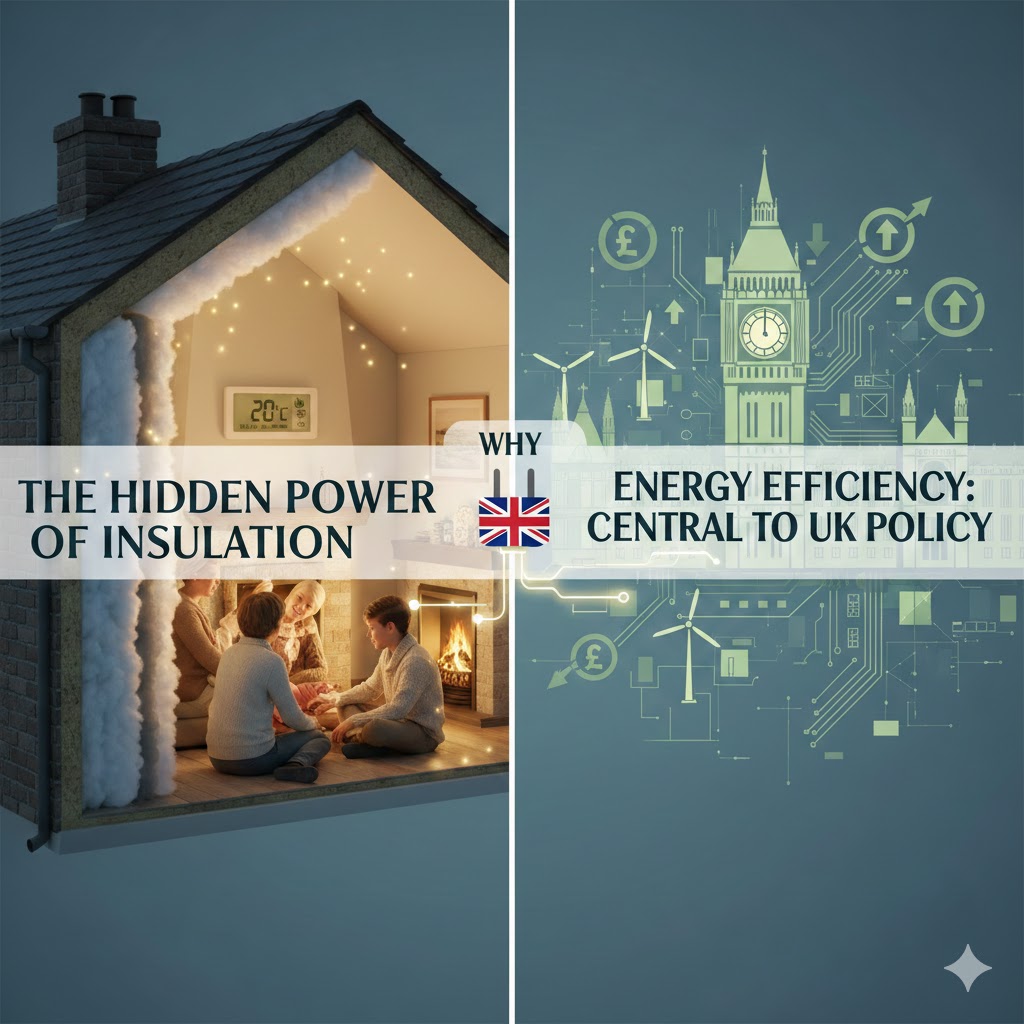
The Hidden Power of Insulation: Why Energy Efficiency Is Central to UK Policy.
Britain’s Leaky Housing Problem
The United Kingdom has some of the oldest and least energy-efficient housing in Europe. Much of the housing stock was built before modern insulation standards were introduced, and a significant proportion of homes still fall below recommended Energy Performance Certificate (EPC) ratings. As a result, many households lose heat rapidly through poorly insulated roofs, walls and floors.
This inefficiency has serious consequences. It increases household energy bills, worsens fuel poverty, and contributes significantly to national carbon emissions. With the UK legally committed to achieving net-zero greenhouse gas emissions by 2050, improving energy efficiency particularly insulation has become central to government policy. Far from being a minor technical upgrade, insulation is now seen as foundational to climate strategy, economic resilience, and social wellbeing.
Energy Company Obligation (ECO): Targeting the Most Vulnerable.One of the most significant policy mechanisms driving insulation improvements is the Energy Company Obligation (ECO) scheme. Introduced in 2013 and currently in its fourth phase (ECO4), the scheme places a legal requirement on larger energy suppliers to fund energy efficiency improvements in eligible households.
ECO4 focuses primarily on low-income and vulnerable households living in the least efficient homes. Measures typically include loft insulation, cavity wall insulation, solid wall insulation and in some cases heating upgrades. By targeting those at risk of fuel poverty, the scheme addresses both environmental and social concerns simultaneously.
The policy reflects an important principle in UK climate governance: decarbonisation must not disproportionately burden those least able to afford change. Instead, energy efficiency measures are framed as a protective intervention reducing bills while cutting emissions.
The Warm Homes Push and Social Housing Upgrades
Beyond ECO, the government has introduced additional funding under broader “Warm Homes” initiatives, including support for social housing providers. The Warm Homes: Social Housing Fund, for example, helps housing associations and local authorities retrofit properties to improve insulation and overall energy performance.
Social housing represents a strategic starting point because improvements can be implemented at scale. Upgrading insulation in blocks of flats or estates delivers collective benefits lower energy use, improved tenant comfort, and reduced carbon output.
These programmes demonstrate a growing recognition that housing quality is closely tied to public health and economic stability. Warmer homes reduce the risks associated with cold indoor temperatures, particularly for elderly and vulnerable residents. In this sense, insulation policy intersects with health policy and cost-of-living support.
Retrofits as the Low-Hanging Fruit of Net Zero
A key challenge for the UK is that most of the buildings expected to exist in 2050 have already been built. New construction standards alone cannot solve the energy efficiency gap. Retrofitting existing homes therefore becomes essential.
Insulation retrofits are often described as low-hanging fruit in climate policy discussions. Compared with large-scale infrastructure projects or complex technological transitions, improving loft or wall insulation is relatively straightforward and cost-effective. The carbon savings are immediate: less heat escapes, less energy is consumed and fewer emissions are produced.
Academic research consistently highlights demand reduction as a critical component of decarbonisation. Instead of focusing solely on switching energy sources, reducing the amount of energy required in the first place strengthens the entire system. Insulated homes support this logic by lowering overall demand, easing pressure on energy supply and infrastructure.
Linking Insulation to the Cost-of-Living Crisis
The recent energy price shocks reinforced the importance of energy efficiency in household finances. When energy costs rise, poorly insulated homes become especially expensive to heat. Insulation therefore acts as a form of long-term financial protection.
Government discourse increasingly links insulation to economic security. Rather than treating energy efficiency as an optional environmental add-on, policymakers frame it as a practical response to high bills. In effect, insulation reduces exposure to volatile energy markets.
This alignment between climate goals and cost-of-living concerns has strengthened political support for retrofit programmes. It also reflects a broader shift in global sustainability thinking, where environmental action is tied directly to social justice and economic resilience.
Insulation as Transformation
Insulation rarely captures public imagination in the way renewable energy projects or electric vehicles do. It is hidden behind walls and above ceilings, largely invisible once installed.
Yet its impact is profound.In the UK context, insulation sits at the intersection of climate ambition, social policy and economic stability. Through schemes like ECO and Warm Homes funding, the government has positioned energy efficiency as a cornerstone of its net-zero strategy. Retrofitting existing housing offers immediate emissions reductions, lower bills for households, and improved living conditions.
Insulation is not merely a building upgrade; it is a structural intervention in how energy is consumed across the country. In a nation with ageing housing stock and ambitious climate commitments, improving insulation is not optional it is transformational.
Leave a Reply