

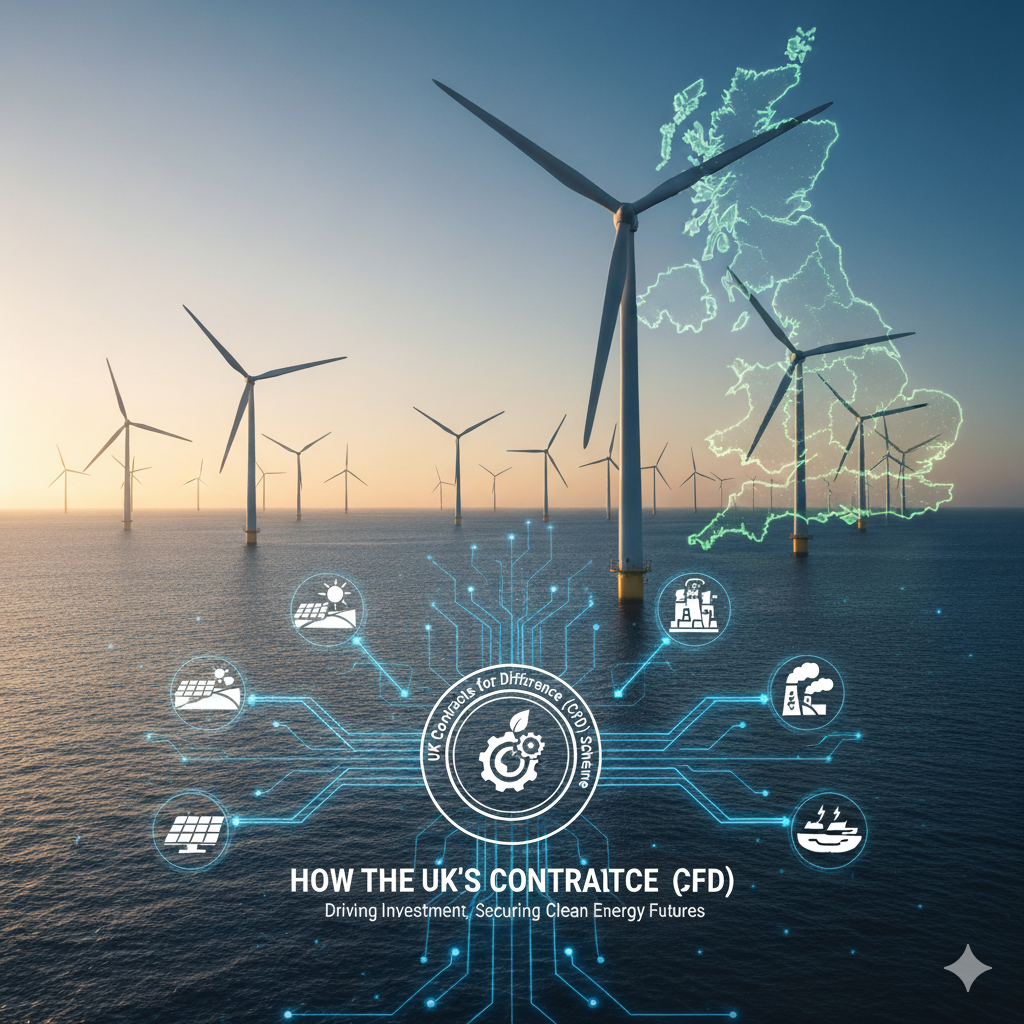
How the UK’s Contracts for Difference (CfD) Scheme is Powering Renewable Growth.
A Quiet Revolution in Britain’s Energy Story
There is a quiet success shaping the future of Britain’s clean energy and it isn’t just the wind turbines along the coast. It is a policy called Contracts for Difference (CfD), a government-backed scheme that has turned renewable energy from a risky investment into a national growth story.
Since its launch in 2014, CfD auctions have driven billions in private investment into clean energy, slashing costs and helping the UK become one of the world’s leaders in offshore wind. In the latest auction round, the country secured almost 10 GW of new capacity enough to power millions of homes. Behind these impressive numbers lies a simple idea: make renewable power competitive and predictable for everyone involved.
How CfDs Make Green Investment Less Risky
At its core, a CfD is a contract between a renewable-energy generator and the government. The developer bids for a “strike price” the price they will be guaranteed for each unit of electricity produced.
f market prices fall below that strike price, the government tops up the difference. If prices rise above it, the developer pays the extra back. This price stability removes a huge amount of financial uncertainty for investors. It means developers can focus on building wind farms or solar parks without worrying about sudden market dips.
By offering long-term certainty, CfDs make renewable energy projects more bankable and attract cheaper finance. In simple terms, that is what turns big, bold ideas into real wind farms in the North Sea or solar fields in the Midlands.
Offshore Wind, The UK’s Big Win
Nowhere has this policy made a bigger impact than in offshore wind. The UK already boasts the world’s second-largest offshore wind capacity, and CfDs have been central to that growth.
Developers know they will earn a stable income for up to 15 years, they have poured investment into cutting-edge technology and larger turbines, driving costs down dramatically.
The result? Offshore wind has gone from one of the most expensive forms of generation to one of the cheapest even beating gas power on price in recent auctions.
The North Sea is now home to vast wind projects like Hornsea and Dogger Bank, creating jobs, powering homes, and helping Britain move closer to its net-zero goals. Without CfDs, this transformation simply wouldn’t have happened at such speed or scale.
The Challenges: Inflation and Strike Prices
Of course, it hasn’t all been smooth sailing. One of the key challenges has been keeping strike prices realistic in a world of rising costs. When supply-chain pressures and inflation hit, developers in a recent auction round chose not to bid at all the prices on offer just didn’t stack up.
Recognising this, the UK government has since raised price ceilings and promised more flexible terms to attract new bidders. It’s a reminder that while CfDs offer stability, they must also adapt to global market realities.
Policymakers are now looking at tweaks like longer contracts and improved access for new technologies such as floating offshore wind, ensuring the scheme stays relevant for the next wave of renewables.
What It Means for UK Households
For consumers, CfDs might sound like something happening far away in boardrooms or at sea but they have a direct impact on household bills.
Yes, the scheme is funded through a small levy on electricity suppliers, but it also protects households from price shocks. By encouraging home-grown renewable energy, it reduces dependence on imported gas and the wild price swings that come with it. In the long term, that helps stabilise bills and ensures the energy we use is cleaner and more secure.
So while you might never see the words “Contracts for Difference” on your energy statement, their effects are there in the growing share of renewables on the grid and the gradual shift toward energy independence.
The Quiet Engine Behind the UK’s Renewable Future
The CfD scheme isn’t flashy or headline grabbing, but it is the quiet engine driving the UK’s renewable-energy success. By lowering investor risk and unlocking billions in clean-energy funding, it has turned policy into real-world progress.
Still, the work isn’t done. The UK must keep refining the system, ensuring fair strike prices and continuing to back innovation in offshore, onshore, and emerging renewable technologies.
If that balance is struck, the CfD will keep doing what it does best powering the UK’s transition to a greener, more secure, and more affordable energy future.
Leave a Reply